Why I'm building a grant finding system for small charities
Not long ago I rang a small charity to do some market research. I asked what eats most of their time in a normal week.
Cam Harvey
Founder, Strive Creative
- Marketed Christmas With The Stars 2025: £70k raised after costs
- Weekly automations running at Imagine This
- 10M+ views in content before that

“Trying to find money.”
It was the first thing they said, before I'd offered a single option.
That call stuck. It's the reason I'm building what I'm building.
Where I'm coming from
I'm Cam. For the last two years I've worked with Imagine This, a UK children's charity, on their marketing, and the automations they use every week: a Monday donor digest that pulls every income source into one email, a copywriting assistant that writes in their own tone of voice, and a welcome series that sends itself. In 2025 I helped market Christmas With The Stars as one of a two-person marketing team, and the event raised £70,000 after costs.
Before that I spent years in content. I built an audience of 60,000 and passed 10 million views, helping founders and creators sell with video. It was good work, but the return was never really there. Moving into the charity sector is the most fulfilling decision I've made.
Why grants
Asking the public for money is hard right now. People don't give willy-nilly to a charity they don't know, however good the cause. I've seen that working with Imagine This.
For a lot of small charities, grants are the lifeline. The trouble is getting to them. You spend hours in databases and guidance notes, with no real idea which funders fit you. Then you spend hours more on an application that might get turned down, and if it was never a good match, those hours are gone. It's soul destroying.
What I'm building
A system that finds the funders that look like a real fit for your charity, checks each one on its own page, and then drafts the application in your voice, ready for you to read, make your own and submit.
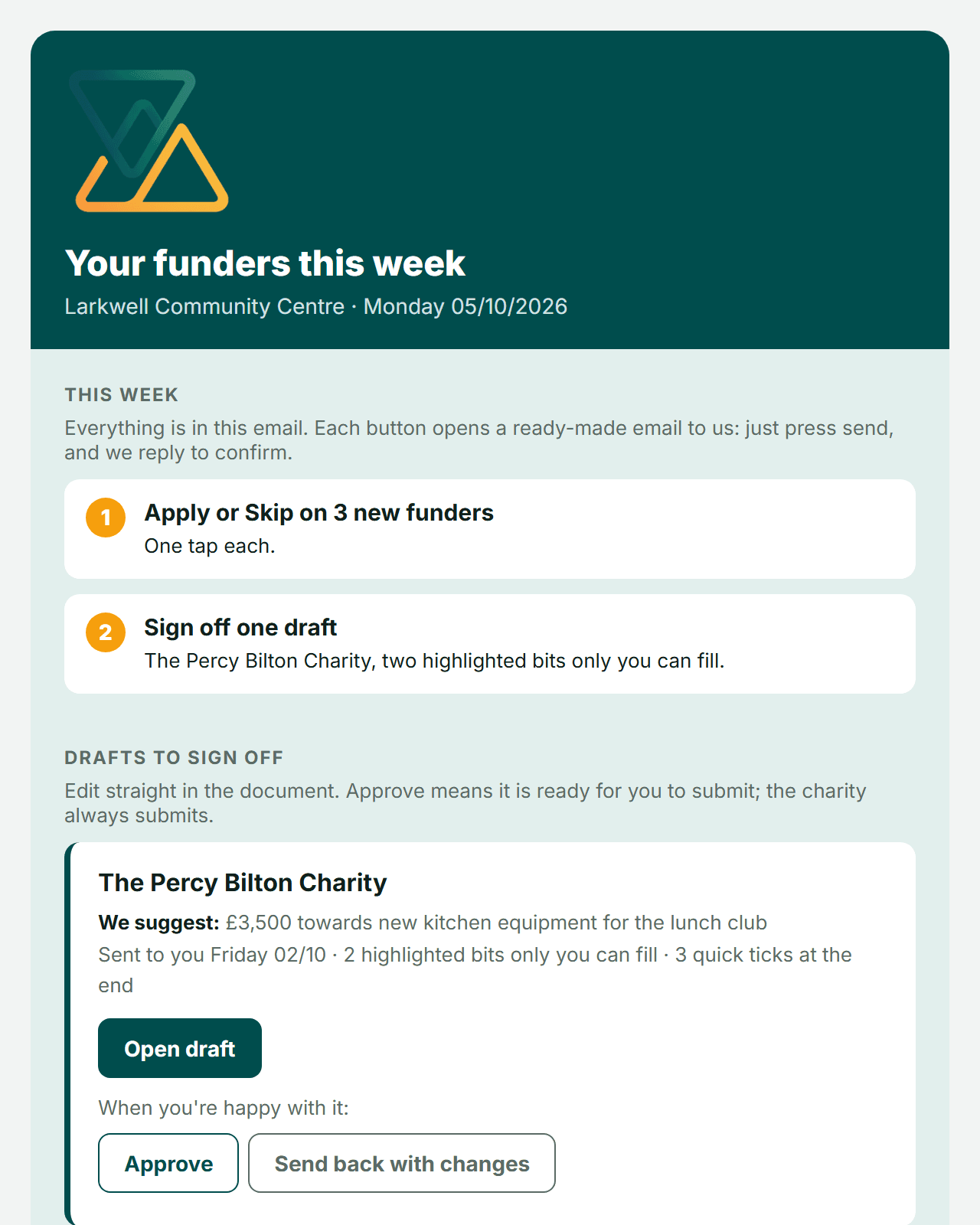
Each Monday the charity gets one email with any new funders, why each one fits and when it closes. One tap says Apply or Skip, and the funders they approve come back as drafts.
Nothing goes anywhere without the charity's approval, and the charity signs and submits every application itself.
How it checks funders
Directories and databases are useful for finding names. But programmes close and income rules change, and the listings don't always keep up. So every fact we show a charity is checked against the funder's own, up-to-date website, with the date it was read, and anything older than a month gets checked again before anyone relies on it.
It makes the system picky on purpose. For one charity, we've looked at 94 funders so far. Fewer than a quarter made the shortlist. The grant has to match, and match well.
What I'm not
I'm not a fundraiser, and I'm not a grants expert. I build systems, and I've built them for a working charity, so I know how the week actually goes for a small team.
The people who've spent careers in trust fundraising know things no system will. What I can do is take the searching and checking off a small team's plate, and get a first draft in front of them.
Why I care
If it works, the reward is grant money landing with small charities that need it. That's what excites me.
If you're at a small charity and finding funders is eating your week, book a 20-minute call. Before we speak, we'll build you a shortlist of 5 to 10 funders you could apply to this week, and it's yours to keep either way. You can also see how it works first.
Or just say hello on LinkedIn. I read every message.